Showing posts with label recipe. Show all posts
Breakfast of Gods
Monday, January 10, 2011
I used to spend Friday nights, or Saturday pre- yoga, or the occasional soggy Sunday morning making “treats”: something special for breakfast. Banana bread (a Friday night favorite), sticky buns (the best take two days), morning buns, chocolate croissants with leftover puff pastry dough (Sunday!), Sour Cream Pancakes (Sunday, too).
Weekdays were for yogurt and granola and hard boiled eggs.
At some point this fall I suddenly realized this made no sense. Monday is the day we all need a little tenderness. Something to soften the ease back to the rush of the working week, time to recognize the coming separation. A little something to compensate for a little sleep debt.
Some Sunday evenings I stir up a batch of oatmeal. We nurse it through the week, adding a little milk or water as needed to warm and moisten (we don’t have a microwave). This Sunday we were behind in our bread-making rhythm-- toast and salmon is another standby for breakfast around -- so I decided to try this recipe for homemade english muffins. But I don’t have a bread maker, and I punched it down after the first rise... maybe 3 hours? and refrigerated overnight. Unbelievably, it rose again in the fridge, and because I got my skillet piping hot,my muffins “popped”, and I had the store-bought-ish number of nooks and crannies (vs.what the recipe and comments describe).
Meanwhile, I’ve bee nursing a bucketload of seville oranges into marmalade. And so this morning we had the blessing of hot homemade muffins with fresh homemade jam. It was the most heavenly breakfast I’ve had in awhile, and a very soft opening to the week.
English Muffins
Adapted from King Arthur Flour
Ingredients
14 oz warm whole milk
3 tbs butter
1 tsp salt
2 tbs sugar
1 large egg, beaten
17 oz flour
2 tsp instant yeast
Directions
Add the yeast to the milk, and then combine the ingredients, in order, in a bowl. Mix after each ingredient, at the end you should have a shaggy, loose dough.
Cover with a cloth and place in a warm spot until double.
Punch down and refrigerate, or allow to rise again for 1-2 hours.
On a lightly floured surface, roll the dough out it until it's about 1/2-inch thick. Cut out circles with a floured 2.5-inch cutter. Re-roll and cut out the leftover dough (I ended up with about 20 muffins).
Let rest for about 20 minutes.
Sprinkle the muffins with cornmeal or semolina.
Heat a cast iron pan until just below smoking, add 5 or so muffins (cornmeal side down), and reduce heat to medium. Cook for 7 minutes, flip, reduce heat further if needed, and cook for 3-4 minutes.
Thick-cut Orange Marmalade
2 lbs seville oranges
2 meyer lemons
4 pt water
1 cup fresh squeezed orange juice
3.5 lbs sugar
.5 lb demerara or other treacle-y brown sugar
Wash the fruit and add it and the water to a larger nonreactive pot (le crueset is great). Bring to a boil and simmer for 1 hour or so, until the fruit is easily pierced with a fork. Allow to cool overnight. You want the water, so just stick the whole pot in the fridge.
Slice the fruit thinly, removing and reserving the seeds.
Wrap the seeds in cheesecloth.
Remove 1 cup of the water, and discard. Replace with the cup of fresh squeezed orange juice (from juice oranges, not sevilles). Add the cheesecloth-wrapped seeds, and bring to a boil. Boil for 10 minutes.
Remove cheesecloth + seeds.
Add the sliced fruit to the pot and return to a boil.
Add the sugar.
Stir over a gentle heat until it is disolved, then boil up rapidly, without stirring, for about half an hour, or until setting point (approximately 220 degrees).
Pour in jars, let sit for about 30 minutes before covering or boiling.
California Christmas
Monday, December 6, 2010
It’s shaping up to be a very California Christmas around here. Christmas lights in palm trees. Boys in Tutus. Walks along the sea, without a coat. Hot chocolate and bare ankles.
I’ve been thinking about what Ohlone traditions at this time of year must have been, too: observation of the seal migration, for sure. Hopefully we’ll do that before too long, but it might be January. Despite my efforts in gathering advent activities--both local and personal-- I don’t really know to much about Mexican advent traditions. I’ve read about La Posada/ La Posarela (I think J is too young this year, but maybe next year), but that’s it.
Mostly, I think J-- and ok, me, too-- might be happy if the “mexican” portion of our observances included a stop at Mitchell’s, say every other day, for a cone of Mexican Chocolate Ice Cream. I think it is my favorite ice cream flavor ever, and I don’t like Chocolate Ice cream. Inspired by that ice cream, and the chocolate spice donut at our local shop, I came up with this cookie for desert for last week’s taco night.
They are spicy, exotic, rich tasting, great with milk or tea or red wine. They are a bit dry, and not super sweet, so I definitely think this is an “adult” cookie, and not an afternoon treat. Unless of course it’s a California Christmas where you are, too.
Mexican Chocolate Biscuits
I cooked these on a lined cookie sheet-- and one sheet was big enough. You could easily make the cookies smaller and use more sheets-- the butter tends to spread, so don’t place them too closely.
1 piece star anise
½ tsp cinnamon
3/4 c flour
1/4 c unsweetened cocoa powder
1/2 tsp baking soda
1/4 tsp salt
1/2 c unsalted butter, room temp.
1/2 c sugar (don’t use turbinado, there isn’t enough time for it to melt well)
1/2 tsp vanilla extract
2 tbs steel-cut oats
1/4 c semisweet chocolate chips
Directions
Preheat oven to 350 degrees. Grid the star anise. Combine star anise, cinnamon, flour, cocoa, baking soda, salt in a bowl. With and electric mixer, beat butter with sugar and vanilla until well blended. Add flour mixture, beat just until dough begins to set. Mix in oats with spatula. Add chocolate chips and beat maybe twice (just to combine).
With your hands, shape cookies into 1 tbs size balls. Place on sheet, and smoosh down.
Bake for 15 minutes, cool on sheet.
We travel like french people... or pioneers
Monday, November 29, 2010
Some might call me picky, I’d say, instead, of course, that I have a sensitive stomach, am hyper aware of the affect food has on me-- my mood, my outlook-- and I’m frugal, but with expensive tastes.
Whatever the excuse, I find that I do a lot of cooking right before traveling. This is a somewhat learned trait, for better or worse. One Christmas I was able to withstand a 6 hour delay on my way home thanks to homemade pate sandwiches and a package of belgian chocolates, courtesy of my mother. For swimming parties, I make lentil salads. Actually, I seem to make lentil salad for almost any outdoor eating event.
This year for Thanksgiving we embarked on the long drive down to San Bernardino County and my in-laws’. We decided to take it slow, spend the night along the way. And since its been so temperate, why not camp along the way. I’ve been dying to take a camping trip with J, and now that he is potty trained it seemed like a perfect opportunity: and there are Yurts in the Santa Cruz mountains.
But anyway.... this trip was no different: a new granola recipe, chocolate biscuits, lentil salad (of course!), pate, plus bread, cheese, pears... for lunch and our afternoon hike. For dinner, we planned to grill hamburgers, toast the buns, roast some red peppers, and make s’mores. And perhaps whip up a salad on the side.
So. We got lost looking for camp, and arrived at our Yurt after dark. And while it has averaged 65 degrees from San Francisco to San Luis Obispo, this week temperatures fell to record lows.
The hamburgers were reliably delicious, and so were the s’mores. The peppers burned, the buns got covered in soot. We had some toast.. and because I couldn’t find the food locker handle in the night, the only other thing we had to eat was the chicken liver pate left from lunch. We smeared it on the toast, drank beer, and chatted with other campers, the guys in the RV who gave us matches, the rangers who gave us firewood. It must have been funny, the city slickers with the toddler totally unequipped in the freezing cold eating pate’, but everyone ate it. ALL of it. And told me they loved it. It was what we had to share, to say thank you.
Every winter I order chicken livers, in anticipation of making lasagna, tortellini, “french” meatloaf. Inevitably, I have leftovers. But this year, it was the 70 degree heat that we had all month that foiled my plans. I didn’t make the lasagna or the tortellini, and not wanting to waste the livers before our trip, I turned to a old standby pate recipe. I love chicken liver pate. It is the perfect picnic food... and perfect for making friends and staying warm when the weather hits 25 degrees and you are sleeping in a Yurt (thankfully in super warm extreme-altitude camping bags, thanks to my crazy x-game brother-in-law).
Chicken Liver Pate, good enough for a yurt.
1 stick butter
1 c finely chopped onion
1 large clove garlic, minced
2 tsp minced fresh thyme
1 tbs minced fresh sage
3/4 tsp salt
black pepper
1/4 tsp ground allspice
1 lb chicken livers, trimmed
2 tbs cognac or armagnac
3 tbs whipped cream
Directions
Melt 1 stick butter in a large skillet over moderate heat. Add onion and garlic. Cook until softened, about 5 minutes. Add herbs, salt, pepper, allspice, and livers. Cook, stirring occasionally until livers are cooked outside but still pink when cut open, about 8 minutes. Stir in cognac/armagnac and remove from heat. Purée mixture in a food processor. Add whipped cream and stir to combine. Transfer pâté to crock/s and smooth top.
Cover and chill at least 2 hours.
Joys of Empire
Monday, November 1, 2010
When I was a very very little girl we lived in London for a while.
I am old enough that this was before the gastro-revolution that’s turned England into a mecca for Mediterranean cooking done comfort style, but, ironically, I think that there was more authentic, and interesting, and veven good food, to be found then-- in the 70s--than now.
England is far to the north; the reason the vegetables traditionally get cooked to death is that they are not particualrly flavorsome left tender-cooked, or raw, or served with just a little aioli. The vegetables need the long cook, the addition of spices, of broths, a little dairy. The Mediterranean style restaurants that dominate the British landscape of today rely heavily on imported vegetables, and obviously, imported cuisine: it’s not authentic to the land, or he people.
Honestly the “nursery food” was pretty awful when I was a kid, but bangers and mash CAN be done right: it simply, like all other cooking, requires a little hand, some presence of mind.
But what I really loved as a child was the immigrant food-- the incredible curries (yes! even as a 5 yeard old!), the chaat, samosas, poori is still my great love. Having never been to India (yet), my marker for all Indian food is always London. And after 300 years, India has had an indelible effect on Britain-- there is more authenticity to eating curry prepared- even by a with britisher- than roasted red peppers
And then there were the regular (monthly?) trips to SoHo. I think it was still, then, a bit gang-landy, but it also (or maybe because) had some of that subversive chic going for it. It was simultaneously slummy and very sophisticated. And I am not quite sure what my parents were doing taking me there, but I loved the food, and still cook some of the dishes from my memory. I think the SoHo Tiger must have made me special kid food, as I haven’t come across Pork Balls anywhere else.Or perhaps Chinese immigrants in London were from a different region than those that have set up shop in the U.S.
Whatever the case, last week,while M was away, I the Pork Balls.J and I ate a whole half pound between us, and I think he would have eaten more. I served these with some steamed bok choy and rice-- but next time I think I might try one or two of the other dishes I remember from London: Mushroom Stir Fry, Spare Ribs, Fish Quenelles. The British do have good meat, and of course the fish is fantastic. So maybe we’ll just have a double portion of Pork Balls, in commemoration. They are that good.
Pork Balls
3 cloves (about 1/2 tbs) Garlic, minced
1 bunch Scallions, finely chopped
3 tbs fresh grated Ginger
Dash of Cayenne
1/2 lb ground Pork
1 Tbs Soy Sauce
1 Tsp fish Sauce
1 Tsp Brown Sugar
1Egg, beaten
1/4 c Flour (or half- and-half mix of cornstarch and flour)
1/4 c Peanut or Safflower oil
Combine the brown sugar, soy sauce, and fish sauce in a small bowl.In a separate, large bowl, place the Pork, and add the garlic, scallions, ginger, and cayenne, one by one, incorporating (by hand) after each-- try to handle only as much as it takes to mix in the spices.
Pour the liquid ingredients over the top and let rest about 20 minutes, then fold in/mop the liquid ingredients, making a large ball of the sausage, but again trying not to “pack firm”.Let marinate for at least 30 minutes or up to 3 hours-- the remaining prep and cooking only takes about 20 minutes total.
Heat about half the oil in a wok or if using a deep skillet, heat all of it. Form pork into 1-2 inch balls, dip in the egg, and roll, very lightly, in the flour. Drop 4-6 balls at a time in the oil, turning down the heat after the first 3 minutes, and turning it back up in between batches. The balls take about 6 minutes each to cook. Add the remaining oil half way through if/as needed.
Drain on paper towels, and serve with rice and soy sauce. I cut a serrano up and added this to 3 tbs soy,1 tsp vinagar, 1 ts dried ginger, as I Iike things a bit spicier than J.
This dish should serve 3-4 with rice and a vegetable... or 2 very hungry people.
Renee
Monday, October 4, 2010
I knew a woman named Renee once. She and I worked together at a small, well trafficked bookstore in SoHo, before SoHo became a Disneyland version of an arts district, before Giuliani. It’s not there anymore-- Spring Street Books-- but I worked there for 3 years or so when I was in college. SoHo already wasn’t the SoHo it had been, and models lived nearby, and there was an Origins at the corner, and a store called Country Road, which I think was the Australian version of Banana Republic. There was also Moss, and Kelley and Ping, and David Bowie shot his scenes for Basquiat
a block away. We had a great magazine department, and Linda Evangelista would come in once a month and buy and armful. Cindy was our favorite, she would buy Barbara Kingsolver
and Jane Smiley
, and came in with Rande Gerber when she was still married to Richard Gere, only we didn’t know it then.
Renee had finished college and gone to South America to teach English, and had become very ill, and had had to come home. She was small, with long brown hair, and was mousy, and had pasty skin. She was slim, too, but it turned out she’d developed Diabetes, but it took the better part of a year to stabilize her health. I don’t remember all the details, but I think there was a family fall out in there too. Anyway she lived around the corner, staying with her college roommate who was now a stockbroker on Wall Street, while she figured out what to do next.
Renee was always so calm, and never recognized anyone famous, and could deal with our crazy boss, Izzy, the holocaust refugee owner of the store. He was friends with the guy who’d written Maus, and Kinky Friedman, or at least knew them well enough for them to stop by and ask for discounts.
Renee was more mature, and more conscious of money than many of our coworkers. I remember the awe I felt the day she said she’d made the curry she was heating up for lunch. Thai curry. This for me was like when other people realize mayonanaise can be made at home, or dill pickles were once cucumbers. It was life changing . I loved thai food, but of course was too poor to afford it often. I was already a good cook, and able top make a nutritious, tasty food most nights, but it had never occurred to me that ethnic food could be made at home, too.
Renee lent me a cookbook
, took me to Chinatown to find ingredients, and invited me over to cook when I was ready to try it for the first time myself. That cookbook is dynamite, and Renee was a great teacher, and Chinatown a great resource.
That Spring Renee got into graduate school for public health, not at NYU, but somewhere out of the city. I am not sure where, or what became of her. But I make a lot of thai food, and whenever my herbs just start to wilt, I make batches of curry paste, and think of her, and how she’d always say to drop by for “tea and sympathy, or vodka and a cigarette” when Izzy was in one of his moods, and she was leaving me to the late shift.
Green Curry Paste
Adapted from Real Thai, by Nancie McDermott
. I am allergic to shrimp so I omit the paste, but you coul include 1 tsp shrimp paste in place of the fish sauce.
Ingredients
1 tbs whole coriander seed
1 tbs whole cumin seed
1 tsp whole peppercorn
3 stalks fresh lemongrass
1/2 c coarsely chopped fresh cilantro roots, stems and leaves
1/4 c coarsely chopped mixed thai basil, vietnamese coriander, italian basil, and mint
1 tsp minced lime peel
1 tbs chopped fresh ginger
6 cloves of garlic, smashed and peeled
1 shallot chopped
1/2 c fresh thai (birdseye) chilies, chopped
1 tbs fish sauce
1 tsp salt
Directions
Toast the coriander, cumin, and black pepper together in a skillet, then pound in mortar and pestle.
Trim the lemongrass stalks and chop finely.
In a food processor or blender, grind the cilantro and mixed greens until roughly processed (5 minutes or so), then add lime, ginger, garlic, shallot, chilies, one by one, pureeing to combine after each addition. Add the toasted spices and lemongrass, then the fish sauce and salt.
This makes enough for 2 to 4 pots of curry. To store, put the ingredients in a jar and cover with a thin layer of neutral oil. Lasts for several months in the refrigerator.
Renee had finished college and gone to South America to teach English, and had become very ill, and had had to come home. She was small, with long brown hair, and was mousy, and had pasty skin. She was slim, too, but it turned out she’d developed Diabetes, but it took the better part of a year to stabilize her health. I don’t remember all the details, but I think there was a family fall out in there too. Anyway she lived around the corner, staying with her college roommate who was now a stockbroker on Wall Street, while she figured out what to do next.
Renee was always so calm, and never recognized anyone famous, and could deal with our crazy boss, Izzy, the holocaust refugee owner of the store. He was friends with the guy who’d written Maus, and Kinky Friedman, or at least knew them well enough for them to stop by and ask for discounts.
Renee was more mature, and more conscious of money than many of our coworkers. I remember the awe I felt the day she said she’d made the curry she was heating up for lunch. Thai curry. This for me was like when other people realize mayonanaise can be made at home, or dill pickles were once cucumbers. It was life changing . I loved thai food, but of course was too poor to afford it often. I was already a good cook, and able top make a nutritious, tasty food most nights, but it had never occurred to me that ethnic food could be made at home, too.
Renee lent me a cookbook
That Spring Renee got into graduate school for public health, not at NYU, but somewhere out of the city. I am not sure where, or what became of her. But I make a lot of thai food, and whenever my herbs just start to wilt, I make batches of curry paste, and think of her, and how she’d always say to drop by for “tea and sympathy, or vodka and a cigarette” when Izzy was in one of his moods, and she was leaving me to the late shift.
Green Curry Paste
Adapted from Real Thai, by Nancie McDermott
Ingredients
1 tbs whole coriander seed
1 tbs whole cumin seed
1 tsp whole peppercorn
3 stalks fresh lemongrass
1/2 c coarsely chopped fresh cilantro roots, stems and leaves
1/4 c coarsely chopped mixed thai basil, vietnamese coriander, italian basil, and mint
1 tsp minced lime peel
1 tbs chopped fresh ginger
6 cloves of garlic, smashed and peeled
1 shallot chopped
1/2 c fresh thai (birdseye) chilies, chopped
1 tbs fish sauce
1 tsp salt
Directions
Toast the coriander, cumin, and black pepper together in a skillet, then pound in mortar and pestle.
Trim the lemongrass stalks and chop finely.
In a food processor or blender, grind the cilantro and mixed greens until roughly processed (5 minutes or so), then add lime, ginger, garlic, shallot, chilies, one by one, pureeing to combine after each addition. Add the toasted spices and lemongrass, then the fish sauce and salt.
This makes enough for 2 to 4 pots of curry. To store, put the ingredients in a jar and cover with a thin layer of neutral oil. Lasts for several months in the refrigerator.
That time of year
Monday, September 27, 2010
We are in a strange season here, fall and Summer, all at once.
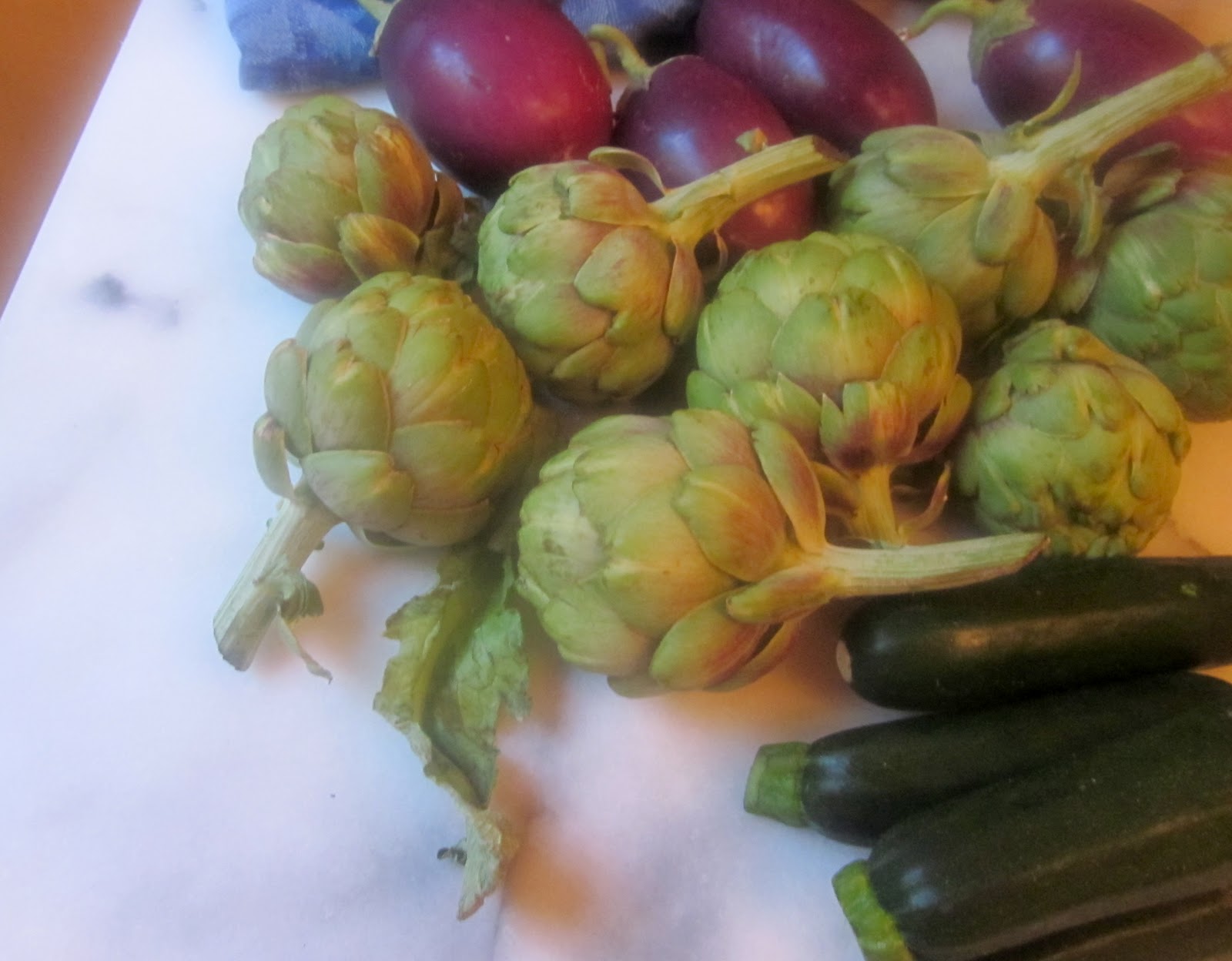
Last week I made braised artichokes, and had 3 blankets on the bed, and the next day made skordalia and baba ganoush. We ate pasta with the last of the zucchinis, and some freezer pesto.
It’s hard to get used to this weather, but I think that’s just because the calender says so. It’s been foggy and rainy and cool with intermittent warmth for a month or two, so it makes sense that now it’s finally warm. and after this will come a little more briskness in the air, later mornings, a return of damp at night.
But the calender isn’t from the northwest, and it says orange leaves, and pumpkins, and spice. It doesn’t say bright fresh tasting chili made with over-ripe tomatoes, the first tiny chilis, some marinated pork and beef. It doesn’t say that now is the season for Thai food (all the ingredients are in the market), the days to be taking a hike, and going lake swimming.
J can’t read the calender, he gets up and asks “swimming open?”, he giggles at the idea of a hike. He asks for shorts. He says it is still time for “green one” (basil). My trustiest clocks: the sky, the sun, and J.
Zucchini Pasta
This is a great cooler summer day dinner dish, one that J gobbles up by the handful.
1 clove garlic
6 small, firm zucchini
2 cups packed fresh basil leaves
salt & pepper
1 pound fusili, or other short, stubby pasta
1/4 cup extra-virgin olive oil
2 tablespoons unsalted butter
1/2 cup mixed grated Parmesan and Pecorino
Directions
Smash and peel the clove of garlic, don't dice
Cut zucchini in to thin (1/4 to 1/8 inch) circles. into 1/8-inch-thick slices.
Warm the olive oil over a low heat with the garlic clove, for about 5 minutes, or until the oil starts sizzling.
Tear basil into thin strips.
Turn oil up to medium-high, remove the garlic (discard), and add the zucchini and 1/4 the basil. DO NOT STIR for 7 minutes. Reduce heat to low and add 1/4 of the basil, season with salt and pepper, put top on the pot until the pasta is ready (but not more than 10 minutes).
Meanwhile, boil water for pasta; cook pasta, reserve 1/2 c cooking water when you drain the pasta.
Combine the pasta, zucchini, butter, remaining basil, 1/4 c of cheese and 1/4 c of the reserved water. Stir to combine and taste. Add more water, salt, pepper as necessary.
Serve with the remaining cheese.
Serves 4-6.
Nourishment: Hunger/Satiation (Stomach)
Thursday, September 16, 2010
A friend’s mother has a saying about food in her house-- “no bags or boxes”, meaning no processed food. I like the saying, makes things clear and easy to remember.
Over the past year-- before I learned the saying!-- we’ve done a lot to work towards a more purposeful/intentional kitchen. By that I mean buying only what we need and avoiding spur of the moment purchases/take out. Making more things I might once thought of as shelf staples, sometimes because it seemed like a fun project, a way to while away a rainy Saturday (1. I LOVE to cook 2. San Francisco gets very rainy), like making our own pate, making ketchup (soooo good, and so much better than Heinz’s).
Sometimes out of necessity: we use Mayonnaise so infrequently it goes bad in between, so it just makes more sense to make small batches as we need it.
But we’ve never kept a lot of shelf-stable food around at all, not really. I grew up in Italy, where refrigerators were tiny-to-nonexistent, food was bought every day at the farmer’s market. My husband grew up in a small town in upstate New York, eating his mother raspberries, helping to can the tomatoes, knowing, intimately, where his food came from.
Part of my desire to make more of my own food is for health purposes: fewer sick days, less doctor visits. But really, mostly, it’s hedonistic. Touching, cutting, cooking, smelling and eating simple fresh food is a wonderful sensual experience, and I see no reason not to do it as much as possible. It is one of the wonderful gifts that nature provides us, beauty and nourishment for all of our senses.
But practically, resolving to eat even less packaged food -- especially with a toddler underfoot -- can be tricky. Lately we’ve gotten it down to the following: 1. pasta (not gonna change unless someone invents at-home brass cutters) 2. granola bars 3. cheese crackers 4. yogurt 5. canned tomatoes, canned tuna, canned crab, mustard, indian pickles/chutney, peanut and almond butter 6. frozen tortellini
We make (most) of our own bread and buns, I make loose granola for breakfast cereal, we make our own ice cream, we buy dried beans, we make our own jam. This summer unfortunately I won’t be able to can any of M’s fantastic tomato sauce, and I like supporting the indian foods vendor at our farmer’s market with my occasional purchase.
Ironically, #2 and #3 are because of J: these are his snacks. I’m sad to think that in some ways M and I eat more healthily than J does. So I’m focusing there, right now. My goal for this year is to reduced our packaged foods to 1. pasta 2. yogurt 3. the canned goods listed above: so I need to nail some sweet-ish treats, and some savory ones, too (although, nuts are a good compromise).
I’ve been working on the granola bars. So far this is the best recipe I’ve found, but ironically it’s a little too sweet for J. This weekend, though, I hit upon a fantastic compromise: low-sugar peanut butter cookies. So full of protein-y energy goodness.
Peanut butter cookies
Adapted from Epicurious
I use organic peanut butter, so that affects my flour and sugar choices.
2 c peanut butter (creamy or chunky)
1/2 c brown sugar
1 c honey
2 eggs
1/4 oat flour
1 tsp baking soda
Directions
Preheat oven to 350°F.
Grease baking sheets.
In a bowl with an electric mixer beat together peanut butter and sugar until combined well. Whisk together eggs and add to peanut butter mixture.
Sift together flour and baking soda, and add to peanut butter mixture, beating all the while.
Roll dough into balls and arrange about 1 inch apart on baking sheets. With tines of a fork flatten balls to 2 inches in diameter. Bake cookies in batches in middle of oven until puffed and pale golden, about 12 minutes.
Makes about 60 cookies.
Walnut Cake, and how to make it with a two year old
Monday, August 30, 2010
I love cake, I love pie, I love tarts, ice cream, sorbet. I never really had a sweet tooth until I was pregnant with J, but I have always loved nut-based confections. Fruit tarts with almond fillings, mexican tea cakes, and my old stand by, walnut cake.
I keep hearing there is some division between cake lovers and pie lovers, but I’m bi-desert: I’ll take either, or both. Except a lot of pie is a it soggy, and I only really like fruit ones with fresh fruit, but a cream pie I can eat whenever. Maybe I’m really a cake person, after all- -or at least now I ma: I love them for their flexibility; once you get past the chemistry of leavening and rising, cakes are much more flexible than other baked treats are: less sugar here, more fruit there, it might be hit or miss at first but it’s workable.
So I decided to try and bake a cake with J, as our first foray into sweets-making in the kitchen. Actually, it was our second: he came in, once, when I was making cookies, ate a bunch of dough, and went to sleep 3 hours late after terrorizing both the cats and unrolling two rolls of toilet paper. So the recipe below is, naturally, one, that works well with less sugar, with honey instead, with stevia; is high in protein, gluten-free, and even has a carrot.
But you know, it’s still cake! And for his second birthday, I made J a version with honey, strawberries, and lots of candles.
“Happy Cake” (Walnut Cake)
This is adapted from an old Saveur Magazine recipe (I get all my best ideas from Saveur), and is apparently a pretty-traditional french desert. I’ve given variations I like, and how I include J in the making at the end.
Ingredients
8 oz shelled walnuts, plus 12 walnut halves
4 oz unsaslted butter
6 oz brown sugar
1 carrot
3 eggs
Directions
Preheat the oven to 350 degrees.
Grease your baking dish, I use a 10 or 12 inch tart pan but you could use a 10 inch pie plate or 10 inch cake pan, just test the cake about 10 minutes early.
Grate the carrot, set aside
Separate the eggs and beat the whites until stiff
Grind the walnuts in a food proecessor until they are coarse-- like rough sand (don’t overprocess until mealy, whatever you do!).
Add the carrot, sugar, butter, and egg yolks, blending quickly after each addition.
Beat in 1/4 the egg whites, then fold the cake mixture into the egg white softly, slowly and carefully until just combined.
Decorate with reserved walnut halves.
Pour batter into baking dish.
Bake for 45 minutes or until tester is clean.
Variations
You could put 6-8 skinned plum/apricot/nectarine halves, halved side down on top of he cake right before it goes in, instead of the reserved walnut halves.
Substitute 1/2 c honey for the sugar and 1 tbs of butter
Substitute stevia for brown sugar, 1 for 1
J tried to grate the carrot but he’s really too little for a box grater, yet. However, I did put all the ingredients into separate bowls, and he happily fed them into the food processor, as usual.Don’t let the kids combine the egg whites, it’s probably too delicate until they are teenagers, even.
For J’s birthday, I made the cake with honey, and slowcooked some frozen strawberries in a little homemade jam, basically making a strawberry puree. About 5- 10 minutes before the cake was ready, I removed it from the oven, preheated the broiler, spread the topping on the cake, and returned the cake to the broiler for 5 minutes.
Cooking with my toddler: Summer Pasta
Monday, August 23, 2010
It used to be easy to toss off something a bit unknown or surprising about Italy, or Italian food. Like the fact that the South is pretty vegetarian and tomato oriented, but it’s the North with the best vegetables, despite the emphasis on meat up there. Or the fact that the further North, the less Olive Oil is used: by the time you get to the Swiss border, it’s just used a dash, maybe in a spring salad dressing. Butter is an almost un-heard of luxury in the South-- even cakes are made with olive oil.
But times are changing, even in Italy. More than fish is eaten on Fridays, and gelato has long been available in Naples.
One thing remains the same, though: Rome is the capital of pasta. Because it’s in the middle of Italy, Rome is called the capital of the “mezzogiorno”, the “mid-day”, in between North and South, in between olive oil and butter, meat and tomatoes. A compromise was forged in pasta. Rome has the greatest array of pasta dishes, and the most with meat sauce (unheard of even 50 miles south-- it’s almost all vegetarian sauce, meat was too special). Beyond pasta alone, Rome is really known for its spaghetti.
I grew up in Rome, and developed an unquenchable taste for pasta. I could eat it for breakfast, for lunch, for dinner, 5 days a week (I want a hamburger, a banh mi, merguez, and some fish, yogurt, fruit, nuts, and some of M’s pizza, once in a while).
J seems to have inherited my pasta-tooth, but to accommodate his little two-year old fingers, I’ve modified a lot of our old pasta standbys to use penne and rigatoni instead of spaghetti. and in keeping with Italian tradition-- different types of sauces are suitable for different shapes of pasta-- I’ve ended up modifying some of the sauces along the way, too.
Tonight J and I made what I’ve taken to calling Summer Pasta. It started out life, years ago, as a version of a recipe in Patricia Wells’ Trattoria
Tonight I added basil for the first time ever, but as always it was a total success: J ate two huge adult size helpings... and so did all the adults.
Summer Pasta
This is extremely easy to make, and while the sauce doesn't require cooking, it's a little more "done" and "saucy" than a pasta salad or pasta primavera. You can substitute any sort of bitter greens for the arugola-- the important thin is that the pecorino and bitter greens combine to give the sauced a kick, while the sweet/acid of the tomatoes mellows that out. Olive Oil binds it all together.
Ingredients
6 oz Pecorino
2 oz Parmesan
2 bunches Arugola or other mixed bitter greens
Sea salt
12 oz Tomatoes (use the tastiest ones you can find-- cherry, heirloom, etc-- whatever it takes. In a pinch I've used a can of Muir Glen)
1/2 c Olive Oil
1 lb Rigatoni
Directions
Shave 4 oz of the Pecorino into a large serving bowl. Rinse and spin the Greens, and tear/shred to bite size if necessary; Add to the bowl. Add salt.
Roughly chop the tomatoes and add them and their juices to the bowl, add a little more salt (this will help bring out the juice). Let sit for at least 10 minutes and up to 30.
Meanwhile, bring water for pasta to a boil, and add Rigatoni; cook as package directs.
Grate the remaining Pecorino, grate the parmesan, combine in a separate bowl.
2 Minutes before the pasta is ready, add the olive oil to the other ingredients and stir together.
Drain pasta and add to ingredients, toss to blend. Serve at he table and pass the additional cheese to top individually.
Mexicali
Tuesday, August 10, 2010
I didn’t use to like Mexican food. I write this with some trepidation, as I live in a large Hispanic community that is grappling with an increasing number of anglo residents, in a larger geographic area that was once part of Mexico... and it just feels disrespectful and unwilling.
Having lived here for about 4 years and in San Francisco for 10 and in California for almost 11 years, I can safely say that what gets sold on the East Coast isn’t really Mexican food, and what gets sold in chain restaurants is just accented fast food, and what gets sold North of Market Street, even, is pretty different.
About 7 years ago after watching the Shawshank Redemption
And I have a confession: I like some faux (or faux-ish) Mexican food, too. Around the time J was born I became addicted to a torta con chorizo verde from Nopalito (very North of Market, also, on the way to the Zoo... an easy habit to make). And try as I might I couldn’t find chorizo verde at Casa Lucas or La Palma, or anywhere else in the Mission.
And a straight google search didn’t turn up anything.
But recently, at our newly reopened library, I saw a copy of Diana Kennedy’s The Art of Mexican Cooking
Anyway, she has a recipe, which I tweaked a little, and we made buns, and I bought some avocados and cabbage and made some salsa, and a corn salad, and J and I made some Watermelon Agua Fresca and I peeled a Mango for desert and it was the best dinner we’ve had in a while.
Chorizo Verde for burgers or tacos
Adapted from The Art of Mexican Cooking. I didn’t stuff and cure these, which you would do for real chorizo, but this preparation was great as a burger (tasted exactly like the sandwiches), leftovers were fantastic in a chorizo scramble, and tacos would totally work with this mixture too-- easy to crumble without drying out too much.
1 lb ground pork
2 oz pork fat (ground fat, or really finely chopped uncured bacon, pork belly, prosciutto, guanciale, etc. would work)
1/2 cup white vinegar (apple cider or rice wine work, too)
1 bay leaf
6 garlic cloves, roughly chopped
1 tsp dried oregano
3 cloves
5 peppercorns
1/2 tbs sea salt
1/4 tsp cumin
1/4 tsp coriander seeds
1 serrano or other small, slim green chile, chopped
1 c loosely packed, roughly chopped cilantro (or 3/4 cilantro, and a 1/4 mix of mint, basil, parsley)
1 bunch swiss chard
Directions
Steam or Boil Chard for approximately 6 minutes, drain and cool, then steam and roughly chop. Set aside.
Combine the garlic cloves, oregano, cloves, peppercorns, sea salt, cumin, coriander in a mortar an pestle and grind until loosely combined.
Set aside.
Put the vinegar in a blender and add the mortared spices, bay leaf, and chili and blend as finely as possible. Possible you could do this all in a mortar and pestle, or the mortar and pestle stuff all in the blender-- but my mortar is too small, and the blender didn’t seem to pound the spices well enough/too my liking.
Add the cilantro, then the chard, making sure that each ingredient is well incorporated before adding the next. You want to turn this into a paste, as much as you can.
Mix the fat and the pork together in a bowl, then add the spice paste, working it in by hand until evenly distributed.
Cover the bowl and marinate 2-24 hours. Form sausages or cook loose, and enjoy.
Cooking with my toddler: Juice and Pops all at once, oh my
Monday, August 9, 2010
J and I made Watermelon Agua Fresca to have with chorizo verde. Also, we made it because the Watermelon was about to go bad. I poured the leftovers into pop molds that night. All in all, this recipe made us very happy.
Watermelon Agua Fresca
2 Watermelons
2 Plums
1/2 c Turbinado sugar
Juice of 2 limes
1/2 c water
1/2 tbs cinnamon
Directions
Chop the plums, and combine with the sugar, 1/2 the juice, and the water in a saucepan over low heat.
Meanwhile, “peel” the watermelons. In the blender, roughly chop about half of it, then set aside. Puree the other half.
Add the reserved juice and puree some more. Strain the puree.
Combine the pureed watermelon with the chopped watermelon and add the cinnamon.
Bring the syrup to a boil, remove from heat and let cool for about 10 minutes-- mash down the plums a little.
Once cool, combine the syrup with the watermelon.
You could add more or less sugar, to taste, or replace the sugar with a bit of substitute-- not corn syrup or honey.
Cooking with my toddler, part 2
Friday, July 30, 2010
I am getting into a groove with cooking with J. Since the pesto pasta experiment, we’ve made feel-better pops (inspired by this post, but I tweaked the recipe: 50% low-sugar cranberry juice, 50% echinacea tea, 100 drops of dandelion extract, a tablespoon of honey), watermelon agua fresca, and Monday night, pasta alle noci.
These recipes are all basically blender/one pot and/or food processor recipes. So I just chop up the ingredients, have them lined up in a series of bowls, and J feeds them in, one by one.
It’s fun, not too messy, and the added benefit is he eats a lot of whatever it is he helps make. And says “I did it myself” a lot, too. Very cute.
Pasta alle Noci
This is a dish I grew up eating on Sunday afternoons at a countryside restaurant. It was served VERY homestyle and I imagine it was made with a mortar and pestle. I think the nuts must have bene a blend of hazelnuts and walnuts, too. It was served on a long thick noodle,maybe all gitarra, or perciatelli size. But as with other pasta recipes, I make this with a short tube so J can feed himself, like penne rigate for this sauce.
Ingredients
1 c walnuts
2 cloves garlic
1 tsp sea salt
1 c heavy cream (NOT whipping cream)
1/4 c pecorino
black pepper
1 lb pasta
1/2 c pecorino and parmesan, mixed
Directions
Toast the walnuts on a baking sheet in a 350 degree oven for about 10 minutes; set aside to cool while you prepare the other ingredients.
Peel 2 cloves of garlic and and combine in food processor with the salt.
Add the walnuts, barely process to chop nuts.
Add cream, mix quickly (can be by hand or with blade).
Add pecorino.
Blend for about 2 minutes
Taste and add pepper-- it should be a little spicy.
Blend some more until you have a thick, whipped sauce-- only til that point, don’t keep processing once it is whipped.
Meanwhile, cook the pasta.
Drain the pasta lightly (ok if there is still some water) and mix in the sauce. Add a little of the blended cheese if needed, up to 1/4 cup. Serve, and pass the extra cheese for each to top their pasta with.
Swimming Salad
Thursday, July 29, 2010
For the past year or so, we’ve had a meat club subscription from (to?) Marin Sun Farms. Lately-- say the last 3 months or so-- “the box” has become our sole source of meat. No extra steak, no sausage for the heck of it, no chicken breasts cause I feel a little lazy.
While it can be a little burdensome/constraining (the meat is frozen and we don’t have a microwave, and our freezer is pretty small, plus, I do like a chicken breast on a whim once in a while), it general it’s been really great. The subscription has allowed me to keep really close watch on our food costs. And I feel good about knowing exactly where all our meat came from, that it is humanely raised with no freaky hormones/drugs. And, it’s the best lamb I’ve ever had, close to perfect pork, excellent steak, and wonderful eggs.
What has surprised me more is how the box has affected my cooking habits and recipe experimentation. We get a package that includes about 5 lbs of ground meat and 2 lbs of “steaks” (steak, but also pork chops, lamb chops, chicken breasts, etc.... so far,though, we’ve only ever gotten steak). That is a lot of hamburgers if you break 5 lbs down to 1/4-1/3 lb per person. And 2 lbs of steak across 2.5 people works out to weird portions, too.
So, now we have a weekly burger night-- we’ve gotten to the point where it’s homemade burger, homemade ketchup, homemade pickle (actually I like Happy Girl's better than my own...), homemade buns (M makes them-- fabulously-- using this recipe). I haven’t tried making mustard yet. But it’s a fun game, just how much of it can we make ourselves-- it relieves what for me would otherwise be the tedium of having to eat a burger every week.
And I’ve gotten pretty good with making beef tacos, we have nachos, I mix some beef into a version of bolognese (I guess I really should call it sugo). But we still have a freezer full of ground beef. I am thinking maybe we need to have a hamburger party. With the ground pork, I’ve learned how to make chorizo verde, created a vietnamese burger recipe, and eaten way to many pork balls (my childhood favorite).
Meanwhile, steak is on the other end of the spectrum. M loves steak and would happily eat a pound to himself every week. However, he’d rather have a steak every week than the whole pound-- frequency is more important than quantity. So I prepare 1 or 2 packages a week (depending on the portion size packaged, which can really vary) carefully, and make interesting side dishes, and a desert.
On hot weekends (all three of them!) this has been sunday dinner: some homemade hummus and toasted pita, a few roasted peppers eaten with a glass of wine while the rib eye or new york strip marinates; boiled new potatoes with lots of salt and cracked coriander, anchovy butter for the steak, cherry tomato and sliced green bean salad, walnut cake.
Ironically, after this sort of meal we often end up with leftover steak. Which we all love in a lentil salad for a quick supper later in the week, or for a picnic lunch on Saturday. For me, lentil salad is one of the emblematic foods of summer. And it is perfect for a picnic-- bright and tangy, but packing a protein punch-- good fuel for a few more hours of swimming or hiking, and no carbs to slow things down (the midday summer sun is enough to make me want to nap, anyway!).
Lentil and Steak Salad
1 c lentils
4 tbs red wine vinegar or 2 tbs red wine and 2 tbs tarragon vinegar
3 tbs extra virgin olive oil
~ 2 diced shallots (a little less than a quarter cup), or 2 tbs red onions or 3 tbs scallions
3 tbs chopped parsley
1 tbs to 1/2 c chopped steak (if you have less than a 1/4 c, increase the olive oil a little, to taste)
Directions:
Sort and rinse the lentils: depending on where you got them,there will be some pebbles mixed in here. I live black (beluga) or green (de puy) types of lentils the best. I don’t think you are supposed to, but I mix a little of each together to get to 1 c.
Put the lentils in a sauce pan and cover with about 3 inches of water, bring to a boil. Turn heat down to a simmer, and cook, without a top. This step is really variable-- some lentils cook in 10 minutes, others in 30. Set a timer for 10 minutes and check every 5-10 minutes after that.
When they are done, drain loosely, i.e. it’s ok for the lentils to be damp-- don’t be too aggressive, you want some extra water.
Immediately toss the lentils with 2 tbs red wine vinegar salt and pepper-- this sort of locks in the flavors, I think the lentils absorb some of the vinegar and it keeps them from turning to mush.
Let sit while you chop up the other ingredients.
Add the olive oil, shallot, 2 tbs more vinegar (or less, to taste-- and here I prefer tarragon vinegar to red wine, gives it all a little kick), parsely and steak. Stir to combine.
Variations:
lamb + cilantro + red onion + lemon (instead of steak, parsley, shallots and tarragon vinegar); salmon + chives + scallions + lemon;
goat cheese (1/4 c) + tarragon or parsley + shallots + your choice of vinegar.
I haven’t tried it with chicken breast, but I don’t think it would be a great flavor/texture combination. You want a protein with a more robust flavor and a defined texture-- in fact, I’d go easy on mixing in the salmon for that reason-- ust lightly, and ad the end, after all other ingredients are in and seasonings adjusted.
The First Time
Tuesday, July 13, 2010
Monday, my son made dinner for the first time. Okay, so I helped, but it was still pretty impressive. He thought so, too, and ate two huge, adult sized helpings of “Pusso-Passa” (Pesto Pasta).
While we do go out to eat occasionally, and our favorite Indian takeout is on speed dial (They include a free Mango Lassie for J everytime!), we make about 90% of our meals at home, and 90% of the food is from scratch. J does have a Clif bar
and Cheerios
addiction, but those are really our only packaged food purchases, besides condiments.
So J’s been in the kitchen since he was born, just like I was. My mother was always so relaxed and happy and confident in the kitchen, and she did MAGIC-- homemade mayonnaise and bread and fudge where my friends had labels and cans. I was so proud of her. The first thing I can remember cooking mostly by myself was scones, when I was about 7. I think the recipe came from Cobblestone
... they tasted great but I think she must have baked a second batch when I wasn’t looking.
I learned how to make pesto from my Momma, who made it every summer when we visited her momma. She’d pick the basil from Gran Jo’s garden (I think it must have been grown just for Momma, often it was leggy and about to flower by the time she picked it), throw in a few sprigs of mint, and grind up cheese she’d bring with us from Italy. And every kid on the block would ask to stay for dinner, garlic and all.
J has been play cooking and asking to help for a few months, but it’s made me nervous, and uncertain. Or house is small, or kitchen smaller, I hate kitchen clean up... but he loves pesto pasta, and this I thought could be done fairly simply with a small child.
So Monday we brought his stool into the kitchen, I grated the cheese and leafed the basil, and one by one we added the ingredients to the food processor. J asked “cheese turn?” “salt turn?” for each ingredient we had lined up. We made it all in the food processor, just adding the ingredients on at a time, in order. He processed it for longer than I usually do, which actually was a good call. And I made penne instead of the usual linguine-- much easier for him to handle. No mess, and we only used one pan, plus the food processor.
Pesto Pasta
2 c packed basil leaves(try to use the smaller leaves on the plant, if yo are growing your own)
a few “other” leaves- i.e. 2-5 leaves of mint, cilantro, or parsely. This will give the flavors a little more depth.
2 tsp salt
2 cloves of garlic
1/4 c walnuts
2 tbs pine nuts
2/3 c olive oil
1/3 c parmesan
1/3 c pecorino
2 tbs butter
Directions
In a blender of food processor, combine the salt and leaves. Next add the garlic (no need to chop prior to adding), then the nuts. Lastly, mix in the oil. Stop the recipe here for freezing. Mix the cheeses together; add 1/2 c of the cheese and the butter if serving immediately.
While we do go out to eat occasionally, and our favorite Indian takeout is on speed dial (They include a free Mango Lassie for J everytime!), we make about 90% of our meals at home, and 90% of the food is from scratch. J does have a Clif bar
So J’s been in the kitchen since he was born, just like I was. My mother was always so relaxed and happy and confident in the kitchen, and she did MAGIC-- homemade mayonnaise and bread and fudge where my friends had labels and cans. I was so proud of her. The first thing I can remember cooking mostly by myself was scones, when I was about 7. I think the recipe came from Cobblestone
I learned how to make pesto from my Momma, who made it every summer when we visited her momma. She’d pick the basil from Gran Jo’s garden (I think it must have been grown just for Momma, often it was leggy and about to flower by the time she picked it), throw in a few sprigs of mint, and grind up cheese she’d bring with us from Italy. And every kid on the block would ask to stay for dinner, garlic and all.
J has been play cooking and asking to help for a few months, but it’s made me nervous, and uncertain. Or house is small, or kitchen smaller, I hate kitchen clean up... but he loves pesto pasta, and this I thought could be done fairly simply with a small child.
So Monday we brought his stool into the kitchen, I grated the cheese and leafed the basil, and one by one we added the ingredients to the food processor. J asked “cheese turn?” “salt turn?” for each ingredient we had lined up. We made it all in the food processor, just adding the ingredients on at a time, in order. He processed it for longer than I usually do, which actually was a good call. And I made penne instead of the usual linguine-- much easier for him to handle. No mess, and we only used one pan, plus the food processor.
Pesto Pasta
2 c packed basil leaves(try to use the smaller leaves on the plant, if yo are growing your own)
a few “other” leaves- i.e. 2-5 leaves of mint, cilantro, or parsely. This will give the flavors a little more depth.
2 tsp salt
2 cloves of garlic
1/4 c walnuts
2 tbs pine nuts
2/3 c olive oil
1/3 c parmesan
1/3 c pecorino
2 tbs butter
Directions
In a blender of food processor, combine the salt and leaves. Next add the garlic (no need to chop prior to adding), then the nuts. Lastly, mix in the oil. Stop the recipe here for freezing. Mix the cheeses together; add 1/2 c of the cheese and the butter if serving immediately.
Fifteenth word (and Blueberry Slump)
Tuesday, July 28, 2009
Some of my ancestors came to this country in the late 1600’s. They pretty much stayed where they landed. Some family came to this country in the late 1800’s, they moved a little. My family that came to this country around 1700 moved and moved and moved, out into the middle of the country. The ones that came to this country in 1918 moved too, south and south and south. I am from this country, but now from the other end of it, and a High Provincialism is in order: I live in California by extreme choice, and except for the days of budget crises and IOU’s, the mashup of technology and nature reflects my personality perfectly.
But in the summer, at least for a few weeks, I tend to wonder what I am doing here. Every summer, for a few weeks, I return to the land of my most ancient forbearers: I spend a week or two every summer on cape cod, swimming, paddling, hiking, and cooking and eating THAT local food.
This summer was the second with my son in tow but really, it seemed like the first, as last year he was not even three months old.
So our vacation changed a little. I had a massage one day, and went running three others, when rain threatened and he napped through the good beach hours. Beach yoga, and visits to the baby beach replaced paddling and hiking. We didn’t make it to as many galleries, to the movies, or stay up as late. It was the best vacation we’ve had in a long time.
We ate lobster twice, and J ate blueberries every morning. He’s enjoyed blueberries at home, and his breakfast of choice for some months has been blueberry waffles. But this was different. He picked them off his grandparents' bushes for a quick snack, had a a bite of cornmeal and blueberry muffin for breakfast, a bowlful for lunch, and gobbled down the Blueberry slump I made for our traditional-last-night-lobster (and bluefish pate, and oysters, and corn)-dinner.
On the plane home, he said to me, twice, “Blueb! Blueb!”. It took me a minute to figure out, but then I pulled out the bag I'd brought with me, and mentally counted "15!" on his growing vocabulary list.
Blueberry Slump
4 cups blueberries
4 small plums, pitted and sliced thin
½ c water
½ c sugar
1 tbs cornstarch
1 tbs grated ginger
1 3/4 cups all-purpose flour
3 tablespoons sugar
1 tablespoon double-acting baking powder
1 cup heavy cream
Instructions
Preheat the oven to 450°F. In a cast iron skillet combine the blueberries, the plums, the water, the sugar, the cornstarch, and the ginger, bring the mixture to a boil, stirring constantly, and simmer it for 5-10 minutes.
Biscuits:
In a bowl sift together the flour, the sugar, the baking powder, and the salt. In a bowl beat the cream until it holds soft peaks, spoon it into the well in the flour mixture and combine the mixture with a fork until it just forms a dough. Most recipes call for then rolling out your batter and cutting the biscuits, which you can certainly do I simply form mine very very lightly by hand, which I find results in an airier texture. However you do it, you want 6ish biscuits.
Drop the biscuits on top of the fruit mixture. Bake in the middle of the oven for 15 minutes, or until the biscuits are lightly golden and the fruit is bubbling.
Strawberry Rhubarb Jam
Monday, May 25, 2009
My mother grew up on a farm in South Eastern Missouri, until she was about 7. Then they all of them, 8 kids and 2 parents, moved to the city. Changed their ways, gave up the chickens, and lived in apartments. Forever, for some of them, like my mother. For her 2 oldest bothers--they must have been 14 and 13 at the time of the great exodus—-it as the opposite: they spent much of their lives trying to get back to the farm, no matter how far afield (2 years in Germany; an eternity in Southeast Asia) life took them, or how successful they became.I spent the summer I turned 12 (or 13?) on the younger brother’s farm, 50 miles away from the one he and my mother, and all the other siblings- had left 25 years before. By then my uncles was on to his second wife, Idele, a computer scientist who taught part time at the local community college when she wasn’t writing theoretical papers on Artificial Intelligence. She had the first computer in town, and she liked to crochet lace to keep her hands busy while watching TV at night.. My uncle, Paul, raised cattle, but couldn’t bear to send the blind ones (Garibaldi) or the overly sweet ones (Dawn) to market. Paul took me fishing, and I watched Idele can 50 jars of Tomatoes, and she tried to teach ye to knit but I thought it was for old ladies, and I accidentally bid on a cow at the livestock auction we stopped at to cool off after they bought an antique organ.
They had rows upon rows of corn, and the best salad. Idele grew bee’s balm to help pollinate the patch of flowers she kept for cutting before visiting my aunts and grandmother in the city.
Paul and Idele divorced 3 or 4 years later, and my uncle moved back to the city, and resumed his career. Married another woman and had another family. I think Idele died about 5 years ago. I’ve been thinking about her in fleeting moments this summer, as I poured jam in to jars, and last night, when I wove in the ends of the scarf I knit for j.

Strawberry Rhubarb Jam
6 cups of strawberries, chopped (roughly, quartered)
3-4 cups of rhubarb, chopped
3 cups of sugar
The juice of one lemon
2 teaspoons of pectin (I use Pomona Pectin, the calcium water is included in the package)
2 teaspoons of calcium water

Directions
Chop fruit and pour into a large stock pot, stir to mix. Add sugar, lemon zest and lemon juice and stir to coat. Let sit for an hour or until juice forms.
Once liquid has formed bring mixture to a quick boil. Reduce heat and cook for 20 minutes or until the fruit starts breaking down. Mash the fruit intermittently.
Remove from heat, and scoop out 1-2 cups of the fruit into a glass bowl.
Whisk pectin and calcium water into the 1-2 cups. Once it is well-combined, pour it back into the kettle/rest of the fruit, and whisk the whole thing until well combined.
Let it cool another 10 minutes or so (not too long or it will be stuck in the pot), and transfer to jars. This makes about 5 cups of jam.
*
I use what doesn't fit into my jars to make thumbprint cookies (this recipe was great).
Watermelon Pickle
Wednesday, May 20, 2009

I remember eating watermelon on the front steps. They were concrete, about 3 of them, rising up from the pavers that led to our house from the sidewalk, and culminating in a brief, broad stoop. Even when watermelon season rolled around, there were cool spots on the stoop: it was partially shaded most of the day, until late afternoon, by our huge twin azalea bushes (the flowers almost the same color as the fruit). Cool stoop, the cool of watermelon in my mouth, juice running down my chin. It always marked the beginning of summer, the first day my mother brought home watermelon. Sometimes she got home from the grocery store after I got home from school, but more often, she’d just finished putting away the groceries when I arrived. So the watermelon was never ice cold, but still cooling off from its trip in the car. I think even in the grocery store--- the supermarket, we always called it, whether it was Giant or Safeway, it wasn’t kept super-cool. At Safeway the watermelon was most often cut up in large-ish chunks: enough for a family of three for desert, or for one hungry child’s indulgent afternoon snack. At Giant, it was left whole, and laid out in hay in the produce aisle. Giant was always more likely to have farm fresh produce, and I imagine the watermelon came in from the Eastern Shore or Delaware early in the morning.
The watermelon in suburban Washington, then, was invariably the shape of a giant pickle: long and cylindrical, green with slightly lighter green stripes. Inside, watermelon-pink flesh and black seeds. I am not sure what it’s horticultural name was, and I am quite certain it never occurred to me watermelon could be anything different.
Tuesday we got our first watermelon of the season, a yellow babydoll: almost perfectly spherical with green skin and sage green stripes, and juicy, yellow, a naples yellow, flesh and black seeds. It is as refreshing as any watermelon, but with perhaps a bit more bite, a hint of spice. Maybe sesame?
We ate the last of it tonight. I have eaten the most, my husband has enjoyed a few slices. Really, I’ve been sick and he’s been indulging me and my love of all thing summer, and let me eat as much and whenever I wanted it (this won’t last) and my son has had his first taste (it made him laugh).
This weekend, we’ll use everything but the squeal, extend the flavor, and make this pickle with the rind:
Watermelon Pickle
2 pounds watermelon rind
1/4 cup pickling salt
4 cups water
2 cups sugar
1 cup white vinegar
1 tablespoon broken stick cinnamon
1 1/2 teaspoons whole cloves
Directions:
Trim the green parts from the rind. Cut rind into 1-inch cubes. Soak watermelon rind overnight in a mixture of the pickling salt and water. If it takes more to cover, use the same proportion salt to water. Drain and rinse watermelon rind. Cover rind with cold water in a large saucepan; cook just until tender.
In a 6 to 8-quart kettle or Dutch oven, combine sugar, vinegar, cinnamon, whole cloves, and 1 cup water. Simmer mixture 10 minutes, then strain. Add drained watermelon rind, lemon slices, and maraschino cherries, if using. Simmer the mixture until watermelon rind is translucent. Fill hot half-pint jars with watermelon rind and syrup mixture, leaving 1/2-inch headspace. Adjust lids. Process in boiling water bath for 5 minutes.
Oranges
Thursday, April 30, 2009

We had a bitter orange tree on our balcony when I was a little girl, but I don’t remember the fruit. I don’t know if it never had any, or if it just wasn’t any good. I do remember using the leaves, in place of lemon leaves, as a topping to a raspberry chocolate ganache torte (the first REAL desert I can remember making) and in a curry-ish recipe, that must have called for lime leaves.
I ate oranges by the pound, though. Blood oranges, tangerines, navel oranges from Sicily. I have a vague memory of lemon fruit pate, and my mother’s key lime pie, but mostly I eschewed other citruses (is that even a word?!) in favor of oranges.
About 10 years ago I read Oranges
One night there I had a grilled fish with savory Meyer lemon curd on the side. One week I had a Meyer lemon custard. Once I had an ersatz pavlova, which of course included Meyer lemon curd. Then I branched out. A drive through Point Reyes yielded Meyer lemon olive oil, I preserved Meyer lemons in salt, from an exceptionally sweet batch I squeezed some juice for breakfast, I’ve grilled them with lamb sausages. So yes, this is my confession: like every other San Franciscan, every other blogger who’s ever written about food, I worship them.
I wait every fall for the first to appear in the supermarket, for my coworkers to bring them in, for the overflow of the CSA box.
And then I make (sweet) Meyer Lemon Curd. Not oh-so-easy, but easy enough for the results:
-nice jars you can give away as gifts
-quick filling for a graham-cracker crust (takes 5 minutes) pie
-perfect with shortbread and berries
-spreadable on toast for breakfast
I needed to whip up a quick treat last night and realized (yes, for the first time) that lemon bars are really just shortbread with lemon curd on top. Only better, apparently, like lemon curd died and went to heaven. “Key ingredient in lemon (heaven) bars” is moving to the top of the list of reasons why I am happy to skin my knuckles for a few hours a few Saturdays a year, when it’s Meyer lemon season.
Meyer Lemon Curd
(These are proportions. I usually make this when I have 3-4 lbs of lemons ready to go)
Ingredients
1lb lemons (=½ c juice + ½ tbs of grated rind)
½ c sugar
2 egg yolks
1 stick butter (1/4 lb), roughly cut into tablespoons
Directions
Zest ½ the lemons— the ratio is ½ tablespoon of zest for a 1/2 c of juice, which comes from about 1 lb of lemons.
Squeeze the lemons, to result in about ½ cup of juice for every pound of lemons.
In a pan over a very low heat, whisk together zest, juice, sugar, egg yolks.
Raise heat to medium/medium-low. Add the butter slowly.
Keep whisking until it is thickened and smooth (on a thermometer, about 160°F.
Let this cool and then put it in a jar, and seal it. Some recipes suggest pushing through a sieve, or adding egg whites. The egg whites make the whole thing take longer to cook, and the sieve is only useful if the mixture isn't cooked evenly.
Lemon Bars
Ingredients
½ lb butter (2 sticks) cold or room temperature
½ c granulated sugar
1 ¾ - 2 c flour
Pinch of salt
½ c confectioner’s sugar
Pre-heat oven to 350°F and butter a 13x9 pan.
Slice the butter into tablespoon pieces then in a food processor, cream it together with the sugar. Add a pinch of sea salt, blend.
Add the flour a ½ c or so at time. Try to use as little flour as possible, just enough to make a pebble-y dough.
Use fingers to press the dough into the bottom of the pan, evenly. It’s far too short to roll out-- think cookie-crumbly-shortbready-thick, not lace cookies or a pie crust.
Bake for 15-18 minutes, until lightly golden on top.
Turn oven down to 325, remove pan.
Spread 1-2 cups of curd across the top (using 1 lb of lemons should be just enough). Return pan to oven for another 18 minutes.
Remove pan from oven and cover in powdered sugar, as quickly as possible (doing this while the bars are hot, so the sugar melts).
Wait 10 minutes for it to cool.
image from lainashea
Cold Sesame Noodles
Tuesday, April 28, 2009

When I was seventeen or eighteen I moved to New York City. I went to NYU that fall, but before then before the studio in the village, the loft in Williamsburg, and of course the dorms, I lived with friends for a summer on the edge of Gramercy Park.
It was a condo in a new-ish building, built over a supermarket. It was a few blocks south of Les Halles, and a few blocks north of the greenmarket. There was a Chinese takeout joint on one corner, and a sushi restaurant on another. A block away a place called Lulu’s served strong margaritas and faux tex-mex to a cocaine-ish after-work/model-wannabe crowd. 80s leftovers.
The Chinese takeout place did lots of stuff well, and I didn’t realize yet how many places did so many of these things well, even better, or how much more there was to Chinese food. In some ways I think my real love of Chinese—szechuan-- food has only come from moving to San Francisco, not a exactly a hotbed of szechuan-nese. Absence makes the heart grow fonder. Mine at least.
I ordered General Tsao’s, which I’d never had before. Pork Dumplings, which tasted like the Pork balls in London. Scallion Pancakes and Fried Rice, better than I’d had in Western Massachusetts (Chinese takeout knows no barriers!). And I ordered, perhaps at my friends’ suggestion, cold sesame noodles.
It gets hot in the summer in New York. That sounds obvious; perhaps it might be better to say that New York in the summer is a re-definition of HOT. But that sounds like a cliche. I am from Washington DC, where it really gets hot. I grew up in Rome, which might as well be part of Africa come August. I guess I think I have HOT bonifides.
Hot in New York in the summer is a different sort of hot. It is perhaps the nastiest grossest hot ever. Stinky garbage piled everywhere. Heat rising off the concrete. It’s gross. Half the city departs for the Hamptons, Cape Cod, Martha’s Vineyard, and the rest of us—you-them- are left to stare at each other. You are left naked in the heat. Can’t wear too many clothes, too tired to mask emotions.
Hot weather food in Washington, on my uncle's farms, on a day I am feeling nostalgic is watermelon. Fruit is refreshing and reviving anywhere on any summer day. But it is so wholesome it's hard to swallow in the grime of an endless July day in New York.
Cold sesame noodles are good cold, room temperature, and lukewarm. They are good after sex, before going out for drinks, for a hungover breakfast. They might actually be nasty hot, and the refrigerator improves their flavor. They are easy to eat, they are easy to make, they are perfect make-ahead food. They make summer in New York bearable, and any meal pleasant.
And now, in San Francisco, babies like small bites, and they are a perfect addition to my lunchbox.
Cold Sesame Noodles
Ingredients
1tbs peanut butter (chunky or smooth is fine)
2 tbs tahini
(OR 3 tbs tahini OR 3 tbs peanut butter)
3 1/2 tbs toasted sesame oil
3 tbs soy sauce
1/4 c water
2 cloves garlic, minced
1 tbs minced peeled fresh ginger
2 tsp rice vinegar
2 tsp brown sugar
1/4 tsp chili flakes or a whole small serrano, chopped
1 lb Asian egg noodles or linguine
3 tbs minced scallion
Directions
Blend together the peanut butter, 2 tablespoons of the sesame oil, the soy sauce, the garlic, the gingerroot, the vinegar, the sugar, the chili paste, and a pinch of salt. In a kettle of salted boiling water cook the noodles until they are al dente, drain them in a colander, and rinse them well under cold water. Retain a ¼ of the cooking water. Mix the cooking water into the paste as needed/for texture (I usually don’t ad or add maybe 1/8 cup, but my husband does ¼, and that tastes good, too)
Drain the noodles well, in a bowl toss them with the remaining 1 tablespoon sesame oil, and mound them on a platter. Let cool for 15 minutes (on the counter or in the refrigerator) and then mix with sauce. Sprinkle them with the scallions + enjoy.
tahini jar photo from erikflickr
Carrot Soup
Saturday, June 28, 2008
There are some obvious benefits to the CSA box-- supporting local farmers, eating more fruits and vegetables,etc. One of my favorite aspects is the forced inspiration-- I have to cook this stuff, and a lot of times that means trying or inventing a totally new recipe (new to me that is).
Here's what I did with several bunches of carrots.
Ingredients
3 tablespoons peanut oil
2 teaspoons cumin
1/2 teaspoon mustard powder
1 teaspoon curry powder
1 tablespoon minced peeled fresh ginger
2 onions, chopped
1 1/2 pounds carrots, peeled, thinly sliced into rounds
finely grated peel of one lime
5 cups chicken broth
juice of 1/2lime
2 tbs plain yogurt
Directions
Heat oil in heavy large pot over medium-high heat. Add spices and toast for about 1 minute. Add ginger; stir 1 minute. Add onions, salt and pepper, stir/cook until onions are turning (5 minutes), then add carrots and lime peel, saute for another 3- 5 minutes. Add broth, bring to a boil. Cover and reduce heat to medium-low; cook for about 30 minutes.
Remove cover and raise heat until soup begins to simmer (NOT boil). Turn off heat, puree until smooth. Stir in lime juice; season with salt and pepper. When cooled a little whisk in yogurt.
Subscribe to:
Posts (Atom)


